

There are several approaches to adding high value to Metal Injection Molding (MIM).
In this technical newsletter, we would like to introduce the benefits that can be realized by combining MIM with PEEK resin.
PEEK is an abbreviation for Poly Ether Ether Ketone and is a type of super engineering plastic.
Because it offers excellent corrosion resistance, chemical resistance, and mechanical strength, it provides significant advantages in fields such as medical devices, semiconductor manufacturing, and precision electronic equipment. In particular, for medical devices that require frequent sterilization and for applications demanding high precision, PEEK is expected to contribute to longer service life and improved safety.
Precise small metal parts production in AM technology
For smaller and higher-precision metal components, sinter-based additive manufacturing is emerging as a promising solution. Unlike beam-based AM, layer thickness can be reduced in proportion to metal powder particle size, enabling the fabrication of finer designs with high dimensional accuracy. In addition, the availability of fine spherical metal powders has increased significantly, thanks to intensive investment by metal powder manufacturers in gas atomisation facilities.
Overmolding PEEK Material onto μ-MIM Components
In recent years, the high-performance material PEEK has attracted significant attention; however, the difficulty of processing it is widely recognized as one of the challenges in product development.Taisei Kogyo has accumulated extensive expertise over many years in plastic injection molding technology and mold design. Leveraging this experience, we have established a proprietary technology in which fine and complex metal components are inserted into a mold and PEEK resin is overmolded (hybrid molded) onto them.
This overmolding technology integrates metal components and PEEK resin into a single structure, enabling not only the formation of precise and complex three-dimensional geometries, but also the achievement of exceptionally high bonding strength and uniform, highly accurate thickness control through in-mold integration. Furthermore, by applying our mold design know-how, we suppress the generation of flash in PEEK resin, thereby realizing a high-precision and stable production system.
This technology fuses the superior properties of both metal and PEEK resin, creating new value for customers' components. By combining our μ-MIM® technology for manufacturing micro metal components with this PEEK resin overmolding technology, Taisei Kogyo is confident that we can open up new possibilities for our customers' product development.
PEEK Coating on μ-MIM Components
PEEK coating is a surface treatment technology based on the high-performance plastic material poly ether ether ketone, which makes it possible to impart the properties of PEEK to metal surfaces.
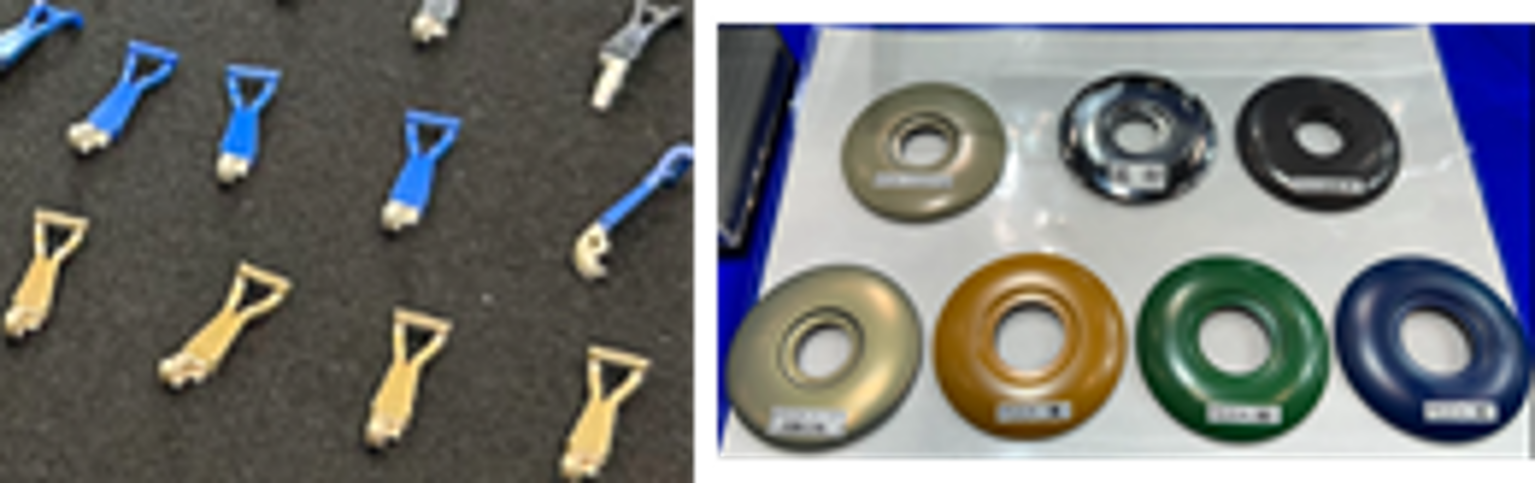
Because PEEK resin is semi-transparent, its color traditionally ranged from light brown to dark brown depending on thickness, which sometimes resulted in less favorable appearance. However, it is now possible to apply colors such as black, achieving improvements in both appearance and functionality. While thicker coatings enhance material properties, excessively thick layers may alter the mechanical dimensions of the substrate. Therefore, selecting an appropriate coating thickness is essential. With the printing method of PEEK coating, a thin film of approximately 20–40 μm can be applied, allowing the functional properties of super engineering plastics (SEP) to be added while maintaining the dimensional accuracy of the base material. Samples utilizing these technologies are also on display at the Healthcare and Medical Device Development Exhibition. If you are interested in MIM + PEEK overmolding or coating, please feel free to contact us for a consultation.
Summary
While applying PEEK to MIM offers many advantages, there are also some drawbacks. One is the high cost, and another is that both technologies require advanced technical expertise.
Since plastic molding has been Taisei Kogyo’s core business since its founding, we have extensive knowledge and experience in handling and molding PEEK resin. Our ability to turn these disadvantages into advantages lies in Taisei Kogyo’s unique capability to work with both metal and plastic, enabling us to provide integrated solutions and technologies.
Upcoming Exhibitions
MD&M West 2026
Feb 3–5 | Anaheim | Booth #3499

Medtec Japan 2026
Apr 21–23 | Tokyo | Hall E7- Booth #309/#409
Download the PDF file
Conclusion
Cracking, slumping or blistering is commonly observed due to the binder swelling and/or residual stress difference between the surface and interior. It is possible to avoid these problems by selecting appropriate organic solvents and temperature control.
The catalytic deboning uses sublimation of binder, thus it is possible to decompose the binder in relatively short processing time with minimizing the deformation. However, with a strong acidic atmosphere, theapplicable metal material option is limited.
In the sintering process, the necking, which is bridging the metal powders by thermal diffusion, starts at the sintering temperature. Once the necking starts, the shrinking is observed and increases the density, thus before starting the necking reaction, all the organic components should be decomposed and gas between the powders should be removed. In the sintering process, the unwanted chemical reaction, such as oxidation or carbonization, leads to mechanical property loss, therefore a precise atmosphere control with low heating rate at the beginning of the process is required. Also, when it reaches the sintering temperature, some add it vegetal can be evaporated.